
Lead
Beyond Scientism and Relativism
Here is a link to my 2010 contribution to the festschrift celebrating Amedeo Giorgi’s career in phenomenological psychology. I pose the question: why should the scientific status of our work be a compelling issue for the next generation of qualitative psychological researchers? I explore the criteria for science proposed by Giorgi, and discuss van Manen’s
[continue reading…]
Feature
 Metodo: International Studies in Phenomenology and Philosophy 10(2) “On History”
Joseph Cohen and Raphael Zagury-Orly’s introductory essay in Metodo: International Studies in Phenomenology and Philosophy 10(2) “On History” begins: “The question of history—its inherent rational, intentional, teleological, eschatological development—has, at least since Hegel, constituted a central focus of philosophical questioning and scholarship. Indeed, contemporary philosophy persistently returns to the necessity of questioning history and the
[continue reading…]
 Investigating religious experience
Davood Gozli and I have begun a discussion on the phenomenology of religious experience on his podcast—he has been teaching cognitive psychology, neuroscience, and theoretical psychology in Macau, China. His book “Experimental Psychology and Human Agency” was published by Springer in 2019. In this discussion Davood refers to my 2019 article in the Journal of
[continue reading…]
 Podcast: Entering Phenomenological Psychology
Here I’m in dialogue with Davood Gozli on his podcast—he is a professor of cognitive psychology, neuroscience, and theoretical psychology who teaches in Macau, China. His book “Experimental Psychology and Human Agency” was published by Springer in 2019. We had a wide-ranging conversation about phenomenological psychology and philosophy, how the tradition has informed my teaching
[continue reading…]
 Phenom Research: What it is, what it isn’t
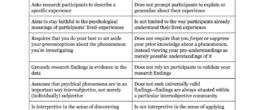
Notes from a seminar I’m giving this weekend introducing phenomenology to psychological researchers. Those familiar with the tradition will see how the epochê, reduction, bracketing, striving for presuppositionlessness, and inquiring into the Other’s natural attitude meanings are represented here–as well the situatedness of research findings–reflecting a particular, psychological interest.
 The layers of conscious life according to Husserl
In my book chapter, “The I and the We: Psychological Reflections on Husserl’s Egology,” I walk the reader through the layers of consciousness and self-hood, as described by Edmund Husserl, founder of phenomenology. This chapter is included in Phenomenology and the Social Context of Psychiatry (2018, Bloomsbury).
Human Science
 Podcast: Entering Phenomenological Psychology
 Here I’m in dialogue with Davood Gozli on his podcast—he is a professor of cognitive psychology, neuroscience, and theoretical psychology who teaches in Macau, China. His book “Experimental Psychology and Human Agency” was published by Springer in 2019. We had a wide-ranging conversation about phenomenological psychology and philosophy, how the tradition has informed my teaching
[continue reading…]
 Masks, Faces, & Defacing
 I’ve been dreaming about masks and social distancing lately. When I go running in my Oakland, California neighborhood I wear a mask. Earlier, during the pandemic I dreamt about running, masked, up a hill where I do actually run most days. In the dream, I found myself avoiding a couple I saw walking, even avoiding
[continue reading…]
 Tokyo Presentation: Intentionality and Narrativity in Research
 This is an expanded version of the presentation I gave at Meiji University in Tokyo on July 30, 2016, as part of a workshop Human Science and Phenomenology:Reconsidering the Approach to Experiences of Others, kindly organized by Dr. Shogo Tanaka of Tokai University and Kayoko Ueda of Kawasaki Univesity. Dr. Ueda, Dr. Masahiro Nochi of the
[continue reading…]
 Scheler, Merleau-Ponty, and “Essences”
 “It is one thing to sift the data of inner observation conceptually and to set them up as compounds, then to decompose these into ultimate ‘simple’ elements and to study through artificial variation by observation and experiment, the conditions and results of such combinations. It is quite another to describe and understand the units
[continue reading…]
 Beyond Scientism and Relativism
 Here is a link to my 2010 contribution to the festschrift celebrating Amedeo Giorgi’s career in phenomenological psychology. I pose the question: why should the scientific status of our work be a compelling issue for the next generation of qualitative psychological researchers? I explore the criteria for science proposed by Giorgi, and discuss van Manen’s
[continue reading…]
Merleau-Ponty
 What was it like to study with Husserl?
 Philosopher Ludwig Landgrebe (1902-1991) was one of Husserl’s closest assistants. Landgrebe’s description of Husserl below was translated by Algis Mickunas, Professor Emeritus, Ohio University, and included by Lester Embree in his Representation of Edmund Husserl: “Almost everyone who first encountered Husserl experienced something of a disappointment at not immediately seeing any external signs of how
[continue reading…]
 The Phenomenology of Dreaming: A Dialogue
 This conversation between philosopher Susi Ferrarello and me began, as is often the case in phenomenology, with an everyday experience: dreaming. My description of a dream led us to reflect on Merleau-Ponty’s discussions of dreaming and waking perception, and Husserl’s active and passive intentionality. The exchange continued over several weeks, and we’ve summarized it here–
[continue reading…]
 Ferrarello: Husserl, Intersubjectivity, and Lifeworld
 Introduction Intersubjectivity can be described as a relationship between me and an other. The peculiarity of this relationship lies in the fact that the other is not alien to me, but is “within me” in a way that his or her “otherness” can be investigated beginning with the way in which that “otherness” is imminent
[continue reading…]
 Key ideas: Applebaum on the phenomenological reduction
 I recently posted a short discussion of what “the natural attitude” means in Husserl’s phenomenology. As I mentioned, the natural attitude is the perspective of everyday life. For Husserl the process he calls the phenomenological reduction is the means by which the phenomenologist frees himself from the reifications of the natural attitude, gaining a standpoint
[continue reading…]
 Applebaum: Introducing Husserl’s phenomenology to psychology students
 This PowerPoint presentation was developed for the first meeting of a seminar introducing psychology students to phenomenological psychological research, and assumes no prior knowledge of Husserl or continental philosophy. The descriptive phenomenological research method itself is introduced in depth over the course of the semester–this presentation is a “first taste” of Husserlian terms for students. Naturally, I added
[continue reading…]
Praxis
 Phenom Research: What it is, what it isn’t
 Notes from a seminar I’m giving this weekend introducing phenomenology to psychological researchers. Those familiar with the tradition will see how the epochê, reduction, bracketing, striving for presuppositionlessness, and inquiring into the Other’s natural attitude meanings are represented here–as well the situatedness of research findings–reflecting a particular, psychological interest.
Phenomenological community versus solipsism Follow the link to my preface to Ferrarello’s book, “Phenomenology of Intersubjectivity and Values in Edmund Husserl.” In this short essay I turn to Husserl’s vision of phenomenology as “wakeful communalization” that must be shared in order to transcend a merely private reflection: Applebaum (2014) Preface to Phenomenology of Intersubjectivity and Values in Edmund Husserl
 Fads, Phenomenology, and Cultural Psychology
 I love Teo and Febbraro’s (2002) observation that “Psychology’s history can be studied as a history of fads” (p. 458). Teo (1996) has written that psychologists “have tended to value meta-theoretical constructions from outside their discipline more than those from inside their disciplines,” with the popularity of these constructions shifting as one or another current
[continue reading…]
 PhenomBlog em Português: Ser um ‘eu’ significa ser ‘único’?
 I’m happy to expand the linguistic diversity of our blog with this post of mine in Portuguese, which I offer with deep gratitude to the colleagues who volunteered to translate it: Eu ensino uma introdução à investigação psicológica para estudantes de doutorado que dura um ano. Muitos dos meus alunos são psicoterapeutas ou estão em
[continue reading…]
 Akihiro Yoshida: Tamamushi-iro-no expressions
 Here is a link to a beautiful essay of Akihiro Yoshida’s, On Tamamushi-iro Expression: A Phenomenological Explication of Tamamushi-iro-no (Intendedly Ambiguous) Expressive Acts. Dr. Yoshida is Professor Emeritus of the University of Tokyo, and Professor of Psychology, Shukutoku University. In Japanese, he writes, tamamushi-iro-no expressions are those that, when spoken, lend themselves to multiple differing interpretations by the one to whom they
[continue reading…]